

Author: C. Franklin
A visit shows you the space. The right questions show you the experience. But how do you know what questions to ask when everything already looks good?
Visits move quickly. Conversations unfold naturally. And by the time you leave, it can be hard to remember what you meant to ask in the first place.
The questions that matter most are often simple, thoughtful, and centered on everyday life. They help you understand how a community works beyond the first impression and whether it truly feels like the right fit for you or your loved one.
With a little intention, the right questions can open up meaningful conversations about how a community supports daily life, relationships, and peace of mind for residents and their families.
If you’ve ever left a visit feeling like you understood the space but not the experience, this guide is here to help. Not with a checklist, but with thoughtful questions that bring clarity and confidence into focus.
So, let’s walk through it together.
What Questions Will Help Me Understand Daily Life?
Some of the most telling parts of your visits to senior living won’t be the ones that get pointed out. It’s easy to walk away knowing what a community offers yet still wonder what daily life there is really like.
Dining rooms, activity calendars, apartment layouts. All part of the picture. But daily life is made up of smaller, quieter moments, and those don’t always reveal themselves on a walk-through.
That’s where thoughtful questions come in.
Questions about daily life tend to bring clarity around how things actually work. How flexible routines really are. How well you or your loved one would be known as individuals. And whether there’s room for life to look a little different from one day to the next.
A few questions that can shift the conversation in a meaningful way:
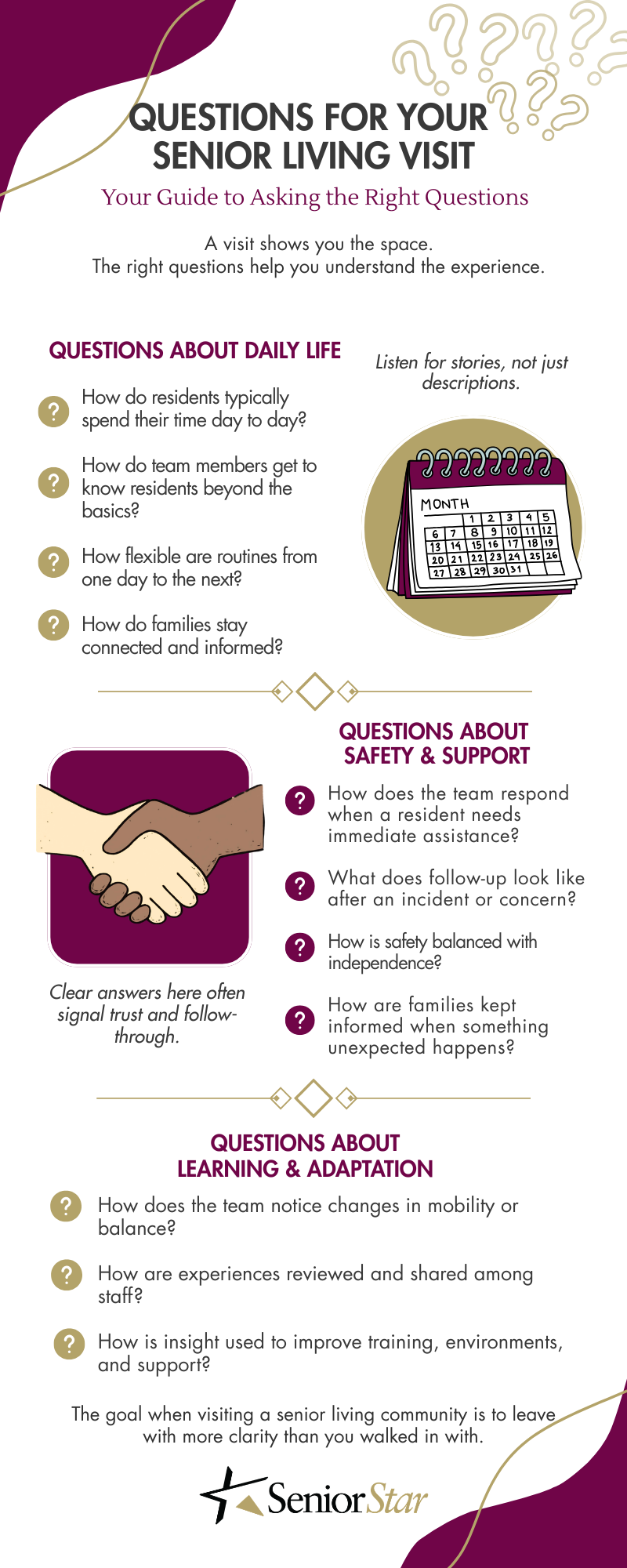
- How do residents typically spend their time here, day to day?
This can offer insight into how personal preferences are supported, and whether the rhythm of the community is structured, flexible, or somewhere in between.
- How do team members get to know residents beyond the basics?
The most telling responses here usually sound like stories, not descriptions.
- What kind of support is available if a resident wants help one day but more independence the next?
This question often reveals how thoughtfully a community balances encouragement, autonomy, and support.
- How do families stay connected and informed?
Communication styles matter. This helps you understand how information is shared and how partnerships are built and maintained.
These questions tend to shift a visit away from presentation and into conversation. They invite stories, context, and real-life examples that help bring daily life into focus, not as a list of offerings, but as an experience that unfolds one day at a time.
And somewhere in those conversations, clarity starts to surface around what matters most:
Can I see myself, or someone I love, feeling comfortable here day after day?
What Safety Questions Should I Ask?
There’s usually a moment during a visit when the questions slow down and the practical ones start to surface. The big picture details are clear, and attention turns to what happens in real situations.
That’s often when safety enters the conversation. Not urgently, not hypothetically, but as a practical curiosity about how a community plans, communicates, and responds when support is needed.
From there, the focus becomes less about policies and more about people. Who notices. Who steps in. How is information shared.
These questions are less about anticipating problems and more about understanding how a community shows up in real, unscripted moments.
At their best, conversations about safety feel steady and matter-of-fact. They offer insight into how prepared a team is, how connected different departments are, and how thoughtfully independence is respected alongside support.
Safety, in this sense, isn’t about controlling every variable. It’s about consistency, awareness, and follow-through. It’s about creating an environment where you or your loved one feels cared for and everyone feels informed, without having to wonder what happens behind the scenes.
Helpful questions often include:
- How does the team respond when a resident needs immediate assistance?
This offers insight into response processes, staffing awareness, and coordination across departments.
- What does follow-up look like after an incident or concern?
Listen for how communication happens, how information is shared, and how learning is carried forward.
- How is safety balanced with independence?
Strong answers tend to reflect respect for autonomy alongside thoughtful support, not one at the expense of the other.
- How are families kept informed when something unexpected happens?
Clear, consistent communication is often a reflection of trust and partnership. This also makes a meaningful difference in how supported families feel.
These questions can feel sensitive, but they often lead to some of the most reassuring moments during a visit. Listen for clear, grounded answers that give a sense of the care, communication, and follow-through behind them.
How Do Senior Living Communities Learn and Adapt Over Time?
Beyond immediate responses, we find many families want to understand something deeper. How a community pays attention. How it notices subtle changes. And how it uses everyday experiences to continuously improve the way support is provided.
This part of the conversation often centers on awareness and learning. Not just what happens in a single moment, but what’s noticed over time and how those observations shape future decisions.
Oftentimes, a loved one having taken a fall comes up here, not as isolated incidents, but as one lens into how a community thinks. Are changes in balance or movement being noticed early? Are patterns discussed openly? Are adjustments made thoughtfully as new insight emerges?
Consider asking:
- How does the community notice and monitor patterns related to mobility or balance changes?
This can reveal whether attention extends beyond individual moments to broader understanding.
- How are experiences reviewed and shared among team members?
Answers here can reveal how information moves through the community and how learning is shared, not siloed.
- How does the community use insight to improve training, environments, and support?
This helps surface whether learning leads to action.
At Senior Star communities, awareness and innovative learning are part of how daily life is supported. Tools like SafelyYou(™) help provide clear insight into when and how falls occur. By reviewing video-based information after an event, teams can better understand contributing factors, identify patterns, and use that knowledge to guide training, environment adjustments, and ongoing improvement.
What tends to stand out in these conversations isn’t the technology or tools themselves, but how they’re used. A willingness to look closely, talk openly, and continuously refine how support is provided as needs change.
When a senior living community team can speak comfortably about how it pays attention, reflects on what it learns, and applies that insight, it highlights a thoughtful commitment to learning that guides how support is shaped and strengthened over time.
Turning a Senior Living Visit Into Clarity
Together these conversations tend to shape how a visit feels. Not by how many questions are asked, but by how the answers sit with you afterward, and the feeling they leave behind.
Often, clarity comes less from what is said and more from how it’s shared, and how it makes you feel afterward. Do responses feel thoughtful or rehearsed? Are examples offered freely? Do conversations leave room for nuance, or feel overly polished?
Paying attention to those details can be just as important as preparing questions ahead of time.
That said, having a few thoughts written down can help keep the conversation grounded, especially when visits move quickly or emotions run high. Not as a checklist, but as a quiet point of reference.
Rather than focusing on specific questions, it can help to listen for a few broader signals throughout your tour:
- Whether daily life feels flexible or fixed
- Whether residents are spoken about as individuals, rather than categories
- Whether communication feels open, steady, and ongoing
- Whether learning and improvement sound like part of everyday thinking at the community
Those cues often say more than any brochure or amenity list ever could.
A visit to senior living doesn’t need to cover everything the first time. It’s one step in a larger process of understanding, reflecting, and decision-making. The goal isn’t to leave with every answer, but with a clearer sense of whether the conversations felt honest, supportive, and grounded in real experience.
Senior Star communities approach visits as conversations for exactly that reason. When questions are welcomed and answers are shared openly, trust has space to grow, and clarity has room to follow.
And that’s often what people are really looking for when they walk through the door.
Click Here for the Downloadable Resource
FAQ
What questions matter most during a senior living visit?
- The questions that matter most during a senior living visit focus on daily life, communication, and how support adapts as needs change. Rather than trying to cover everything, it often helps to ask questions that invite stories and examples, which can reveal how a community truly functions beyond the first impression.
Is it appropriate to ask about safety and falls during a visit?
- Yes. Questions about safety, communication, and fall awareness are a natural part of the conversation. Thoughtful communities expect these questions and are prepared to discuss how they would support you or your loved one, share information with families, and continue learning from experience.
How can families tell if a senior living community is the right fit?
- Fit often becomes clearer through conversation rather than features. Paying attention to how openly questions are welcomed, how residents are spoken about, and how examples are shared can offer valuable insight into whether a community feels supportive and genuine.
What if a senior living visit doesn’t answer every question?
- That’s common and completely okay. A visit is one step in a longer decision-making process. Many people leave a strong visit not with every answer, but with a clearer sense of whether the conversations felt honest, steady, and grounded in real experience.